Front discharge mixers have the drum over the cab. They're less common here, and we buy them the same way.
Value at a glance
What a mixer's figure rests on
Chassis, engine and transmission
Drum shell and fin wear
A drum drive that turns both ways
Axle setup, boosters and lift axles
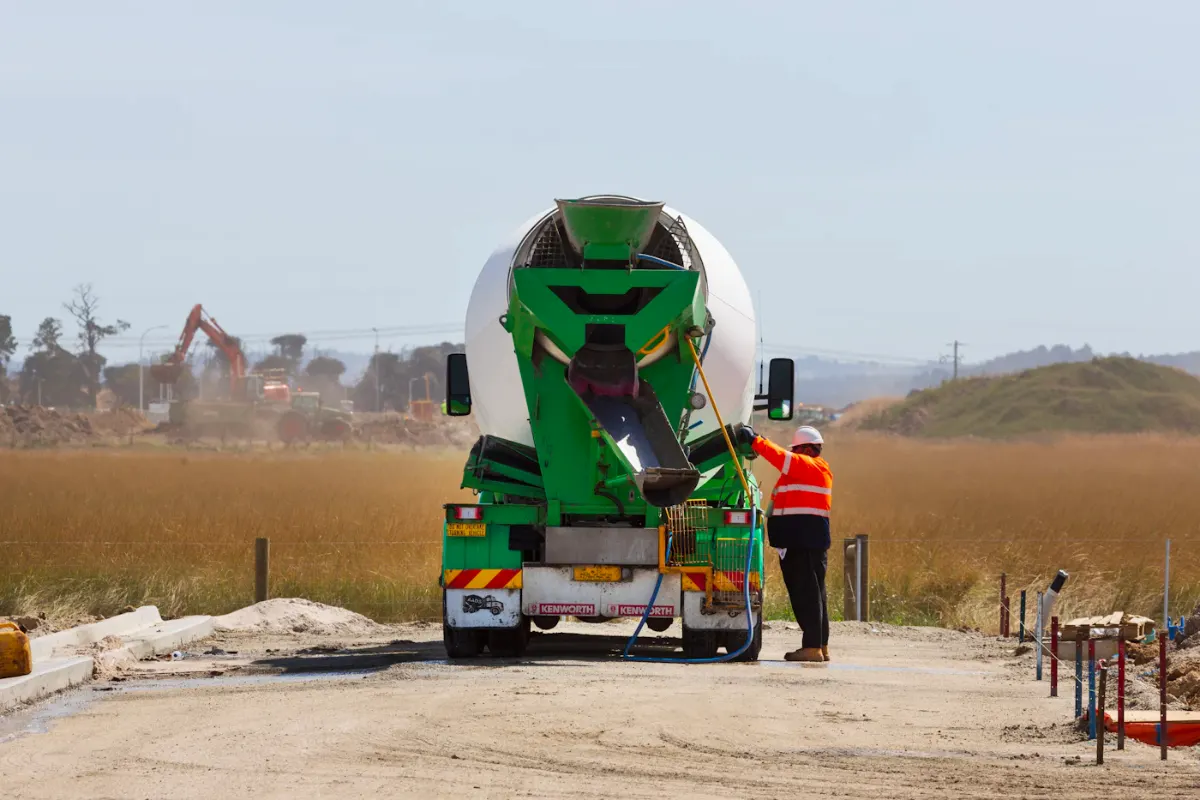
A mixer at the pour. Chutes, fins and drums all wear.
Mixers in depth
What sets a mixer truck's value
Rear discharge, front discharge, short or long, these are the details that count.
Rear or front discharge
Rear discharge mixers are the most common in the Lower Mainland. Front discharge trucks, with the cab and chute at the front, are valued differently and have their own buyers. Tell us which you have. Either way, the chassis, the drum and the drum drive set most of the value.
Drum size
Larger drums carry more concrete per trip but need heavier trucks with more axles. Tell us the rated size from the drum plate. A drum size that matches what local ready-mix companies run is easier to sell on as a working truck, so size matters for value as well as for moving it.
Axle setup
Tandem, tri-axle and trucks with lift axles or a trailing booster all come up. Each changes how the truck can be moved if it doesn't drive and what it can legally carry if it goes back to work. Tell us how many axles there are and whether the lift axles and booster work.
Engine and transmission
Heavy-duty diesels and automatic transmissions that are popular with fleets hold their value, because parts and mechanics are easy to find. Tell us the engine make, model and kilometres, and the transmission type. A recently rebuilt engine or transmission is worth mentioning; so is a known failure.
Chutes and controls
Missing chute sections, cracked chute pivots and broken rear controls lower the value a little but don't stop a sale. Tell us what's missing or broken. Cab controls and rear controls that both work make the truck easier to put back to work, which helps the figure.
Fleet retirements
Ready-mix companies retiring several trucks can have them priced together or one by one. We can collect them over a few days so the yard keeps working. A short list with unit numbers, years, chassis makes and drum sizes is a good start, and photos can follow.
Frame and suspension
Mixers carry a lot of weight, and frames crack, especially around the drum pedestals and the booster mount. Tell us about any frame welds or known cracks, and the condition of the springs or air suspension. Photos under the truck near the front and rear pedestals help.
Drum drive
The pump, motor and gearbox that turn the drum are one of the most valuable parts of a mixer. A drive that turns the drum smoothly in both directions adds real value. One that leaks, whines or turns slowly is a known repair. Tell us what you've noticed.
Cab and electrical
Cracked windshields, worn seats and broken gauges barely move the figure. Electrical problems that stop the truck from starting or the drum controls from working matter more. Tell us whether the truck starts, whether the dash lights up and whether the drum controls respond.
Questions
Common questions
Do you buy mixers with a worn-out drum?
Yes. Thin shells and worn fins get priced in.
What if the drum won't turn?
That's fine. A dead pump, motor or gearbox is priced as it sits.
Do you buy tri-axle mixers?
Yes. Heavier trucks go out on a heavy wrecker or lowbed, which we arrange.
Does drum wear lower the offer?
Yes, somewhat. A drum with thin shell steel or worn fins needs work before it can mix again, so it's valued lower. It still counts for its steel and its drive parts.
Do you buy front-discharge mixers?
Yes. Front-discharge and rear-discharge mixers are both bought. Tell us which kind you have and the drum size in cubic metres.
Do you need the water tank and chutes?
No, but a complete truck is worth more. If the chutes, extensions or water tank were removed, tell us when you call.
Mixer out of the rotation?
Send the chassis, drum make and photos. One offer, tow included.